
Home › App Anti-Cheat
In one paragraph: a phone-first poker app like KKPoker defends itself with a layered integrity stack, not a single check. It verifies the device environment (is this a real, unmodified phone?), it verifies its own code at runtime (has the binary been tampered with?), and it watches how the account plays over time. Bots and automation tools usually trip at least one layer — because the very tools that enable automation on mobile are the same artefacts these checks look for.
This is a research-oriented walkthrough of how integrity systems are typically built in modern mobile poker apps. It is generic to the category — the same principles appear across major app-first rooms — and it is written to explain mechanisms, not to provide a circumvention guide. Where it touches KKPoker specifically, it does so as an example of an app-first product rather than a desktop client.
Why mobile changes the threat model
On desktop poker, the classic bot lives outside the client. It captures the screen, reasons about the board, and drives the mouse. The poker client often can't even see the bot directly; detection leans heavily on play-pattern analysis after the fact.
A mobile app flips that. There is no convenient "outside" on a locked-down phone. To automate, an attacker generally has to do one of three things: run the app on an emulator instead of a real phone, root or jailbreak a device to gain the access automation needs, or repackage / hook the app to inject control. Each of those changes the environment in ways the app can measure. The mobile threat model is therefore less "spot the bot in the hand history" and more "spot the tampered environment before a hand is even dealt".
Layer 1 — Environment and device checks
The first thing an integrity stack establishes is what it is running on. The questions are concrete:
- Is this an emulator? Emulators leave fingerprints — synthetic hardware identifiers, missing sensors, default device names, telltale CPU and GPU strings, and timing characteristics that differ from physical silicon.
- Is the device rooted or jailbroken? The presence of root management tools, su binaries, writable system partitions, or known rooting frameworks is a strong signal that the normal app sandbox can be bypassed.
- Are hooking frameworks present? Instrumentation toolkits used to hook running apps leave loadable modules and process artefacts that can be enumerated.
Modern apps don't roll all of this by hand. Platform attestation services let an app ask the operating system vendor whether the device and app are in a known-good state, signed by the vendor rather than self-reported. That moves the trust boundary off the (potentially compromised) device and onto the platform, which is much harder to spoof.
Why a single check is never enough
Any one environment check can be defeated by a sufficiently motivated attacker — emulator fingerprints can be patched, root can be hidden. The design assumption is that each layer leaks. The strength comes from stacking independent checks so that an environment which passes one still fails another, and from feeding the residual uncertainty into server-side review.
Layer 2 — Runtime attestation and tamper detection
Passing the environment check isn't enough; the app also has to trust that it is itself. Runtime attestation asks: is the running code the same code that was signed and shipped?
- Code signing & integrity verification — the app checks that its package signature matches the original publisher and that critical code segments haven't been altered.
- Anti-hooking and anti-debugging — the app watches for debuggers attached to its process and for function hooks redirecting its own calls, both classic tools for reading or rewriting in-app behaviour.
- Repackaging detection — cracked or modified builds (re-signed with a different key, resources swapped) fail verification against the expected signature.
For an automation author this is the painful layer. Driving a phone app reliably usually means modifying it — injecting an accessibility hook, patching a method, or repackaging the client. All of those are exactly what attestation is built to surface. An automation that works by reading and driving the genuine, unmodified app from outside is far harder to build on mobile than on desktop, precisely because the platform sandbox doesn't grant that access to a normal app.
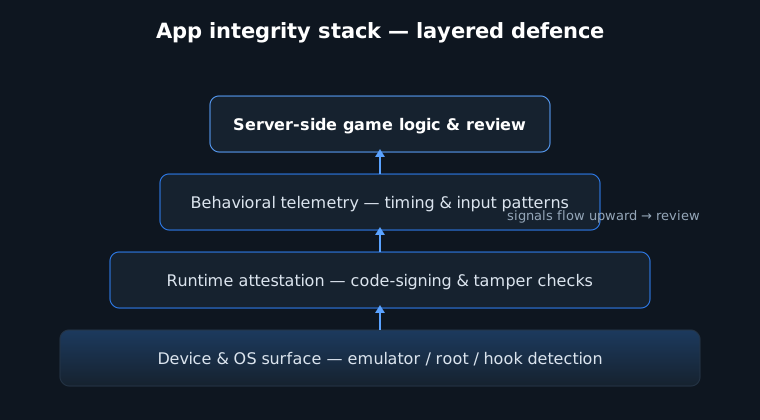
Layer 3 — Behavioral telemetry
Environment and attestation checks defend the boundary. Behavioral telemetry defends against everything that gets past it — including a human assisted by an external solver on a separate device, which leaves no on-device tampering trace at all.
Behavioral systems model how a normal human plays and flag deviations:
| Signal | What looks human | What looks automated |
|---|---|---|
| Action timing | Variable, context-dependent pauses | Constant or suspiciously precise intervals |
| Decision quality vs. time | Harder spots take longer | Fast, near-optimal play in complex spots |
| Bet sizing | Human-rounded, occasionally inconsistent | Solver-precise sizes repeated exactly |
| Session rhythm | Breaks, fatigue, drift | Long, metronomic, fatigue-free sessions |
| Input geometry | Natural touch jitter | Identical tap coordinates each time |
None of these are conclusive alone — plenty of strong humans play fast and size precisely. Telemetry produces a risk score, not a verdict. High-risk accounts are routed to human review and correlated with the environment and attestation signals already collected. A passable solver play pattern on a flagged emulator with a tampered binary is a very different case from the same pattern on a clean, attested phone.
Server-side review ties it together
The reason all three layers feed upward is that the deciding logic lives on the server, where the app can't be patched away. Cards are dealt server-side; the client only renders them. That means a bot can read what the human sees but can't see hole cards it isn't shown, and can't rewrite the outcome. Server-side correlation also catches patterns no single device reveals — shared funding, synchronised sessions, or improbable result distributions across "unrelated" accounts.
Where this leaves bots on KKPoker
Putting the layers together: automating an app-first poker product is expensive and high-risk. Emulators and rooted devices are loud signals; repackaged clients fail attestation; machine-regular play is visible in telemetry; and the server holds the cards regardless. A skilled operator can still attempt it, and an external solver on a second screen can dodge the on-device checks — but it then has to beat behavioral review with a real human in the loop. On club apps, the more reliable way to extract value rarely involves a solver at all. It involves people: the collusion and chip-movement risks that live in the club and union structure.

Researching app integrity or bot detection?
Compare notes with a poker-software researcher.
Talk to us