
Home › Club System
In one paragraph: KKPoker organises play around clubs grouped into unions, with agents handling players and staking arrangements behind many accounts. This social structure is what makes the app work — shared liquidity, local recruitment, trust networks — but it is also where the real integrity risk sits. The hardest problems on a club app are usually human: collusion, soft play and chip-dumping between people who know each other, not a lone solver-bot grinding tables.
To understand bot and integrity risk on KKPoker, you have to understand how the game is organised socially, not just technically. The anti-cheat stack defends the device and the client. The club system defines who is even at the table and how money flows between them — and that is a different kind of attack surface.
The building blocks: clubs, unions, agents
Three layers sit between an individual player and the operator.
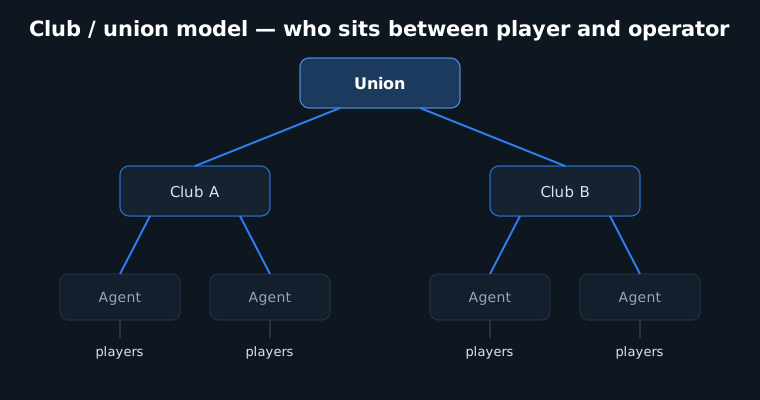
- Clubs are the basic social unit. A club is a closed group of players, usually recruited through personal or regional networks, that runs its own games. You generally need to belong to a club to take a seat.
- Unions are alliances of clubs. Because a single club rarely has enough players online at once to fill games at every stake, clubs join a union to share a common pool of tables and liquidity. The union is effectively the engine that keeps games running.
- Agents are the people who recruit and manage players within a club. They handle onboarding, balances and day-to-day support, and they sit between the club operator and the individual.
This is the same model that powers most Asian-market club apps. It solves a real problem — liquidity for private, trust-based games — but it also concentrates a lot of discretion in agents and union operators.
How staking and chip movement work
Two money flows matter for integrity: staking and chip movement through agents.
Staking is when a backer funds a player's action in exchange for a share of results. It is completely legitimate and common across all of poker. But on a club app it means many accounts at the table may not be playing purely for themselves — the economic interest behind several seats can trace back to the same backer, agent, or staking group.
Chip movement happens through the agent layer rather than an open public cashier. Players settle balances with their agent; agents settle within the club; clubs settle within the union. This keeps the social structure self-contained, but it also means value can move between accounts in ways that are not as transparent as a single regulated cashier with public deposit and withdrawal records.
The key consequence
When the same economic interest can sit behind multiple seats, and value can move between accounts through private settlement, the integrity question stops being "is one of these players a bot?" and becomes "are these players actually independent?" That is a question about people and money, not about emulators and binaries.
Where the real risk is: collusion vs. solver-bots
It's worth separating the two threats clearly, because they are not equally important on a club app.
Solver-bots
- An account playing automated, near-optimal poker
- Caught by the app anti-cheat and behavioral telemetry
- High build cost, high detection risk on a mobile app
- One seat, capped edge
Human collusion
- Multiple real players coordinating against others
- Soft play, whipsawing, chip-dumping to a target account
- Enabled by the trust networks inside clubs and unions
- Many seats, compounding edge
Collusion is the harder problem precisely because it uses legitimate mechanisms — real players, real staking, real agent settlement — to disguise coordination. There is no tampered binary to detect and no emulator fingerprint to flag. Detection has to come from the network and economic layer: who funds whom, which accounts repeatedly avoid confronting each other, where chips reliably end up after sessions, and which results across "unrelated" players are statistically improbable.
How the structure interacts with anti-cheat
This is why a club app's defence can't stop at the device. On-device checks answer "is this seat automated or tampered?" The club system forces a second question — "is this seat genuinely independent of the others?" — that no amount of root detection can answer. The two have to be combined:
| Threat | Primary defence | What it looks at |
|---|---|---|
| Solver-bot on one account | App anti-cheat + behavioral telemetry | Device environment, code integrity, play timing |
| Multi-accounting | Device & funding correlation | Shared hardware, IPs, payment paths |
| Soft play / collusion | Network & hand-pattern analysis | Who avoids whom, improbable fold/raise patterns |
| Chip-dumping | Economic flow analysis | Consistent value transfer toward target accounts |
Takeaway
The club and union model is the heart of how KKPoker delivers private, liquid games — and it's also why integrity on a club app is mostly a human problem. A solver-bot has to beat the layered anti-cheat to even stay seated, and it still only controls one chair. A coordinated group of real players, settling quietly through agents inside a trusted club, can do far more damage while leaving no tampering trace at all. Anyone reasoning seriously about "KKPoker bots" should spend at least as much attention on the people at the table as on the software running it.